April 28, 2026 at 6:20 a.m.
“Flowers Are Red” by Harry Chapin and Standardization

Recently, I heard the song, “Flowers Are Red,” performed by Dale Sechrest at a Harry Chapin Tribute.
As a former teacher, the song touched me.
As the story goes, which Dale so well shared, Harry's secretary's son received a note from his teacher stating: "He marches to the beat of a different drummer but will soon join the beat of others.”
The boy wishes to use multiple colors when coloring a flower, but the teacher insists he makes the flowers red and the leaves green. The boy refuses and serves time-out. Eventually the boy wants to rejoin his class and adheres to the wishes of his teacher. When moving to another school, the teacher encourages students for an assignment to make their flowers multiple colors. When looking at the boy's artwork, the teacher is wondering why all of his flowers are two colors. The boy responds,
“Flowers are red, and leaves are green.”
So Harry, not one for conformity, wrote “Flowers Are Red.”
When teaching fifth graders for thirty-six years, I would always stress CCD which stood for Colorful, Creative, and Different while explaining it might give them an edge in a competitive world. I would then hold up a white sheet of paper and share how a Japanese table tennis friend held up such a paper in my presence and said, “I want my life to be filled with multiple colors representing multiple experiences.” I would then discuss with each class the importance of their artwork having many colors and proudly claiming it.
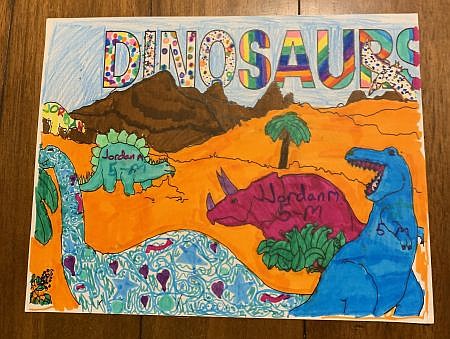
Dino was an imaginary character who lived in the small study room in the very back of our classroom. If a fifth grader was being disruptive, I often blamed Dino, and the indirect approach to the issue would usually resolve it. One of our first assignments was to color a dinosaur picture for Dino after a rather innovative introduction. I would encourage CCD. Consequently, I received very colorful, creative, and different pictures, and they were then posted in Dino's Room which pleased Dino. They added greatly to the atmosphere of the room which all students could freely go to at times. Artistic work flowed throughout the year in regard to assignments and projects.
When developing as a teacher, I got much better understanding the importance of allowing students freedom in expressing themselves. However, standardization can be stifling. And, the dollar amount spent on standardized testing in Indiana and the United States each year is staggering. Of course, testing companies are benefiting. When retiring and celebrating, I wrote a song expressing my feelings, “My Child Is More Than A Test,” which I think Harry Chapin would appreciate. If interested in the song, you can Google Sally Webster Albums. One review states, “The song challenges the intense focus on standardized testing and reflects the writer's belief in children's potential.”
I couldn't say it any better; my sister, Sally, who worked with children with special needs for forty-four years, could not say it any better. Sally even had to take and pass a test to continue as a teacher assistant, an academic test that had little to do with the care and love she demonstrated each day.
It seems all educators and students should fill out a survey at the end of yearly standardized testing sessions to be sent back with the tests for important feedback. When teaching and administering the tests, I was never given that opportunity; my students were never given that opportunity. It also seems parents should be allowed to share input. Test makers aren't in classrooms. It is my sincere hope no child allows such testing to define them or defeat them.
May flowers always be multiple colors; may the flowers of my grandsons and all children be multiple colors.
Note: While constructing this article, I found out the song, “Flowers Are Red,” is thought of as the unofficial anthem for the Crayon Initiative's Organization. Their mission is for children to incorporate all colors and to be creative while providing recycled and free crayons to over 240 hospitals for children throughout the United States. If interested, Google Crayon Initiative.