March 4, 2026 at 8:30 a.m.
President Benjamin Harrison Home Tour

Not long ago, we traveled to Indianapolis and had a guided tour through the home of our 23rd U.S. President and Indiana's only president, Benjamin Harrison, with our good friends, the Slagels. The 10,000 square-foot-Victorian home has 16 rooms within the three stories as well as a basement and contains mostly original furnishings and many artifacts and has a museum on the spacious third floor which was the ballroom. Tickets were reasonable, and we did not have any difficulty parking on site with my wife wisely choosing the first session for that reason. The steps are somewhat steep, but there is now an elevator if needed.
I picked up a paper with highlights of President Harrison's personal life and professional life. Below, you will find a few of the many listed:
“*August 20, 1833: He was born in North Bend, Ohio.
*1840: Grandfather William Henry Harrison (Ohio) is elected as the 9th President of the United States (only served one month due to an illness taking his life).
*Planned to study for the ministry, however, he shifts interest to law.
*October 29th ,1853 [sic]: Marries Caroline Scott at Oxford, Ohio. Ceremony is performed by her father, Reverend John W. Scott.
*His father is elected to the House of Representatives, as the Whig from Ohio.
*April, 1854: Harrison moves to Indianapolis to begin his law career. He was appointed court crier at $2.50 per day.
*Diary resolution: 'Stopped use of tobacco in every form.'; Soon reverted to cigar smoking.
*Is elected Elder of 1st Presbyterian Church, a position he held until his death.
*July 1862: Enlists and forms Indiana's 70th regiment of the Union Army volunteers. He is appointed second lieutenant and 13 days later is promoted to Captain.
*Wins the promise of brigadier's star by General Hooker at the Battle of Peach Tree Creek.
*January 17, 1881: Elected to U.S. Senate.
*Receives an official notification of his nomination for president at his home in Indianapolis.
*July - October 1888: Delivers over 80 campaign speeches to 300,000 people in Indianapolis.
*March 4, 1889: Inaugurated as the 23 rd President by Chief Justice Fuller.
*Was the central figure in the Centennial celebration of Washington's 1st inauguration in New York, and he initiated the crusade to fly the American Flag over every schoolhouse.
*August 22, 1889: Dedicates the Soldiers and Sailors Monument in Indianapolis.
*December 1889: Has the first decorated Christmas tree in the White House.
*1889 - 1890: North Dakota, South Dakota, Montana, Washington, Idaho, and Wyoming are admitted as states.
*The Pension Appropriation Bill is passed, providing improved pensions for veterans and families.
*July - August 1890: The White House is renovated including the installation of electricity.
*Sequoia, General Grant, and Yosemite are approved as National Parks by Congress. (Harrison set aside more than 13 million acres of public domain for national forest preserves.)
*April 14 - May 21, 1891: The presidential speaking tour of the south and the Pacific 1891 Coast (round trip of 9,232 miles); made over 140 impromptu speeches on the trip.
*Caroline Harrison dies in the White House due to tuberculosis.
*November 8, 1892: Defeated in presidential election by Grover Cleveland; trailed in popular vote and lost in the electoral vote.
*Winter 1895: Earned income is $50,000.
*1896: Publicly declines to be GOP candidate for President.
*Publishes the book 'This Country of Ours.'
*March 13, 1901: Dies from complications of pneumonia.”
During the tour, wonderful actors portrayed President Harrison and his wife, Caroline. We found out some interesting things not on the list. Wallpaper adorned the walls, very similar to what the Harrison family had when there. Mr. Harrison was quite concerned he would never see his family and friends again while serving in the Civil War and stressed the importance of never taking them for granted. He discussed the gaslight fixtures fed by extensive piping in the home until it was renovated in 1896 with electricity added as it also had been installed in the White House earlier. Mrs. Harrison was quite the artist and masterfully created her own Chinaware which was used at the White House and can now be found within the home's China cabinets in the dining area. She was very pleased with her kitchen, in particular the Hoosier cabinet, which saved her and her help many steps. The home even featured an early plumbing system, later updated during the electrical work. They took eleven family members and several animals (a goat, two opossums, dogs, even two alligators) to the White House and found many rats there. Ferrets were brought in to help control them. One of their grandsons, Baby McKee, enjoyed rides on a cart pulled by the family goat, His Whiskers. Once, the goat with the grandson on the cart got away from the family and was being pulled around the streets of Washington D.C. with President Harrison chasing him down. Of course, it made the newspapers with Republicans and Democrats looking at it differently, imagine that. Women prided themselves on 20-inch waists during this period and would go to great trouble maintaining it, at times leading to health problems, including passing out due to the pressure applied to their bodies by corsets. I later found out there were possibly fainting couches for women to recover from their tight lacing even though that seems to be debated when researching.
Hope's Jean Glick was Education Director at the Benjamin Harrison estate for a short while and had these remarks: “I enjoyed my time working there. One of several highlights was portraying Caroline Harrison in the dining room when school groups visited, some from the Columbus area. The facility is blessed to have very dedicated volunteers, and they were of great assistance to me and whoever walked through the doors.”
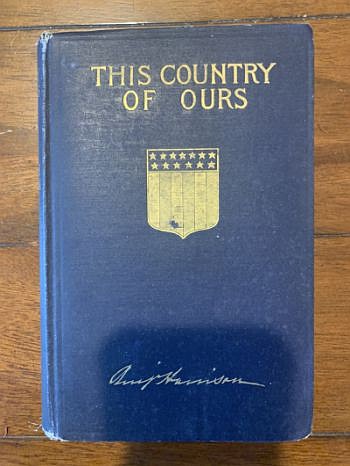
There are several books about President Harrison. I was interested in buying a copy of “This County Of Ours” by President Harrison. In searching, I found the original edition is understandably worth much more than the edition I purchased dated 1915 and published by Charles Scribner's Sons.
The book's purpose is within the short Preface and ends with these words: “It is to give a better knowledge of things that have been too near and familiar to be well known. We stumble over things that are near our toes. I hope it may also tend to promote an intelligent patriotism and a faithful discharge of the duties of citizenship.”
The Introduction follows the Contents listing twenty-one chapters related to the government's structure, seven about The President, while ending appropriately with the Constitution Of The United States in the Appendix. There are several points within the Introduction I found of interest:
“A government is made strong and effective, both for internal and foreignness, by the intelligent affection of its citizens.”
“If we would strengthen our country, we must cultivate a love of it in our own hearts and in the hearts of our children and neighbors; and this love for civil institutions, for a land, for a flag, -if they are worthy and great and have a glorious history -is widened and deepened by a fuller knowledge of them.”
“The old Declaration has a pulse in it and a ring to it that does the soul good.”
“Watchfulness, administration, and love are needed to keep the best-planned government on its projected lines.”
“Every man and woman ought to have a chance to choose his or her side, without regard to station, or wealth, or race, or color.”
I found the seven chapters about all the roles of the president quite intriguing, and they reminded me of the complexities and the vast responsibilities of the position. In addition, I was reminded of the time and effort in creating our foundation, the Declaration of Independence in 1776 and the Constitution of the United States that soon followed, the greatness of these documents and the greatness of the United States of America. Presidents come and go, but these documents remain. We are indeed very fortunate, and I m thinking about that very much as we celebrate 250 years as a nation.
I would encourage you to visit the home of former Indiana President Benjamin Harrison. Like me, you will likely do much reflecting. On the website, you will find this quote from President Harrison, a quote which I really like, “Great lives do not go out, they go on.”