September 30, 2026 at 10:05 a.m.
The Yellow Trail Museum: Hope's Agricultural History - A Must See
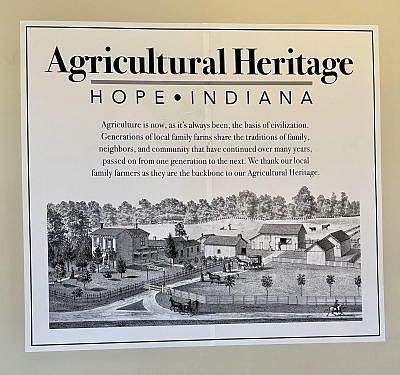

I purposely went to the Yellow Trail Museum to view the Farming Exhibit when first hearing about it and was so impressed that I recently returned to do this deserving article.
Debra Slone, well known for her creative work, had much to do with the exhibit and had these remarks, "The concept for this exhibit was to first provide the story with words, photos and artifacts of our local agriculture history that once put Hope, Indiana in the spotlight nationally and internationally. Second, we wanted to showcase our local farmers, past and present, and to share history of local businesses that were a support system.
“The exhibit was a coordinated effort by myself, Kim Ray and Kathie Clouse which required many devoted volunteer hours," she adds. "Vendor Jill Anderson worked her computer magic bringing our concepts to life as well as Bob Anderson who printed the wall displays and banners.”
My focus for this article is what area farmers had to say on several banners throughout, a small sample of the many farmers in our area but a wonderful sample. You need to visit to read all of their reflections.
John Perry Simmons recalled the tough times: “During WWII, gas, tires, tractors and farm equipment was rationed. We managed to buy one of three tractors, a Farmall M, allotted to Bartholomew County in 1944.
“A farmer's biggest asset is a poor memory. He'll buy seed corn confident that he'll raise 150 bushels to the acre. He looks to the future, and doesn't remember last year's drought.”
And Gladys added, “My Grandma Glick boiled all of her white things in soapy water, washed on a wash board and rinsed in two waters, one with bluing. There was a high priority on white, white laundry.”
Debra (Seward) Slone stated, “When you had dairy cows, you never went on vacation. My sisters and I wished for a brother or two to help with farm chores. Never happened!”
Ivan Seward had one of my favorite quotes because it reminded me how my dad was a master of fixing things on our farm: “You can fix anything with bailing wire.”
Tom Beeker chose a very powerful phrase: “The Bible was written for farmers, and about farmers.” Bill, Dan, and LeaAnn (Lentz) Lane combined to share: “Our grandparents bought the farm in 1940 after having to move because the war department took their home and farm in Clark County to make ammunition-it had been in the family for over 150 years.
“Our parents and grandparents valued the work ethic. We never met anyone who worked harder. They instilled that value in us.”
Tom Lentz made the farm his entire career: “I only had one job for the last 89 years. All I ever wanted to do was farm.”
William Carr Lentz got philosophical: “In farming, it's hard to set goals-you just try to do your best every day and opportunities arise. For life is full of opportunities and decisions, and the Lord's hand guides them all.”
Jay and Nancy Shoaf were told they just would not make it, but they tried anyway.
“With no money, we borrowed operating money from the bank with a handshake and name recognition to plant our first crop-which half was destroyed by hail," Shoaf said. "With little money, we did odd jobs and cut and split by hand 256 pickup loads of firewood to sell to make enough to cover the borrowed first year farm payment. With hard work, determination and good neighbors, we made it.”
Jennifer (Clouse) Swope expressed her passion for farming quite well: “Being the next generation means understanding the farm truly belongs to the generations before and after. Decisions need to be made with the future in mind. It is crucial to be humble, hard working and to believe is something much bigger than yourself, because a lot of what we do is out of our control."
“I want to leave the farm better than what I found it so that there is potential for my children," she continued. "It requires a lot of sacrifices, but the process uncovers many blessings, and I can't imagine life any other way.”
Evan Clouse remembers how it was putting up fence years ago: “You had to dig all the post holes, set the posts, tamp, let set, then stretch the fencing all by hand. Today you bring in the Bobcat with a post driver, accomplishing in one day which before took two weeks. Modern technology has significantly reduced time and labor.”
Dylan Smith from the Hatton farm called upon an old saying, “Plant in dust, your bins will bust.” Then Jeff Hatton followed that with another old one, “Bend the iron while it's hot.” Each idiom has much wisdom.
Marvin Finke felt there was a better and traditional time to plant your crops: “Make sure you are planting while the locust trees are blooming.”
As John Finke grew older, he faced what a lot of farmers go through: “Because of health reasons, I could no longer milk and couldn't find help. So I went from 120 dairy cows to 65 Angus beef cattle.”
Located at the very bottom of this particular banner are words from George Washington. George said, “Agriculture is the most healthful, most useful and most noble employment of man.”
James Stafford worked at the elevator during his junior high days stating, “I made batches of food for many farmers for an assortment of livestock needs. There are exceptions, but for the most part livestock production has changed a lot in the last 50 or 60 years.”
Seth Baute recalls his grandpa, John Perry Simmons, referring to an old traditional forecasting adage, “All weather signs fail in a drought.” Nathan Downey simply put it as, “You have to be smarter than the animal you are dealing with.”
Matt Marlin had several noteworthy statements: “I prefer horsepower that stops eating when I put it in the barn.
“What other business would spend a million dollars on a single piece of equipment that they know they are only going to use one month of the year.”